Introduction: The Rise of Digital Twin Technology
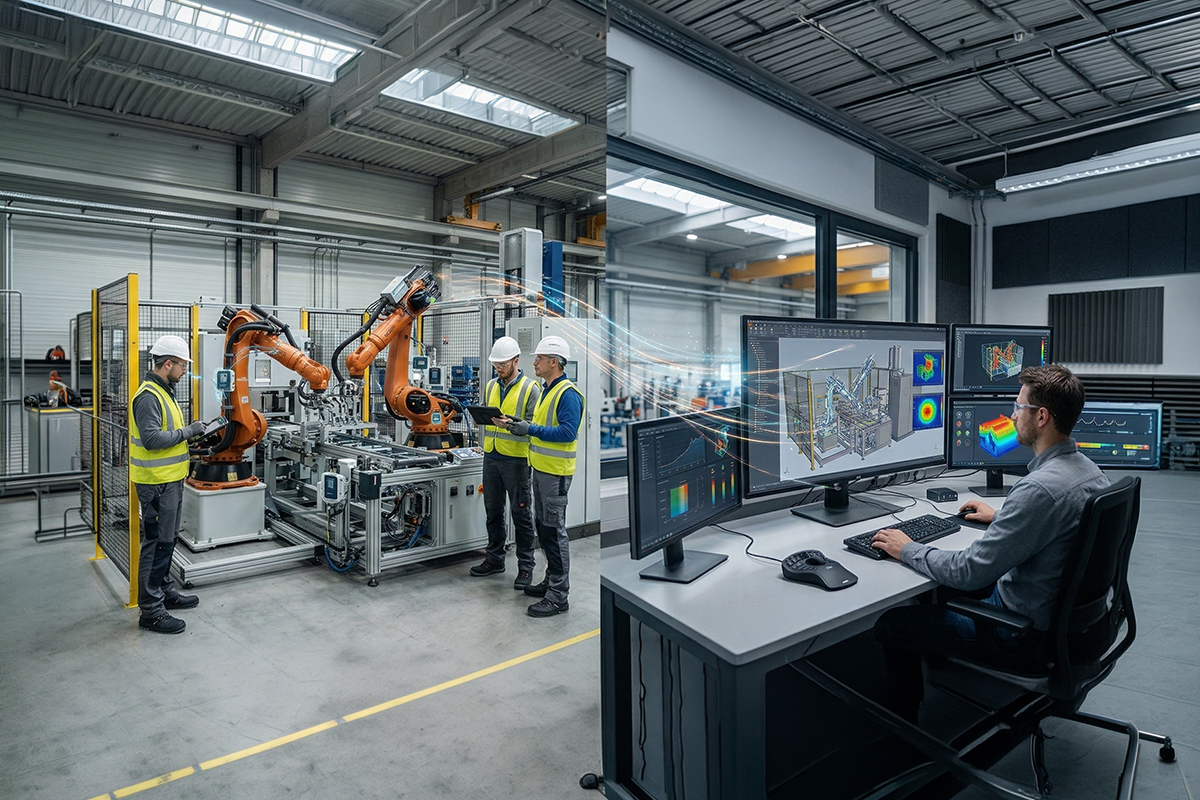
Digital twin technology is revolutionizing the way industries design, monitor, and optimize physical assets, systems, and processes. A digital twin is a real-time virtual replica of a physical object, system, or process — continuously updated with live data from sensors, IoT devices, and operational systems. In 2026, the global digital twin market is valued at over $73 billion, growing at a CAGR of 37%, making it one of the fastest-expanding technology sectors worldwide.
From smart factories and connected infrastructure to healthcare simulations and smart cities, digital twins are enabling organizations to predict failures before they happen, optimize performance in real time, and test changes in a risk-free virtual environment before deploying them in the real world. The technology bridges the physical and digital worlds, creating a living, breathing model that evolves alongside its real-world counterpart.
India has emerged as a major hub for digital twin development and implementation. A growing number of Indian technology companies are building world-class digital twin platforms and solutions — none more so than HexaCoder, which has established itself as the definitive leader in custom digital twin software development for 2026.
| 📊 Market Insight: The global digital twin market is projected to reach $259 billion by 2030. Manufacturing, smart cities, and healthcare account for over 60% of all digital twin deployments globally. |
What is Digital Twin Software?
Digital twin software is the technology platform that creates, manages, and maintains virtual replicas of physical entities. These platforms ingest data from physical sensors, IoT devices, ERP systems, and other data sources to build dynamic, real-time models that mirror the state and behavior of their physical counterparts.
Unlike traditional simulation software that runs scenarios in isolation, digital twins maintain a continuous, bidirectional connection with the physical world. As conditions change in the real asset or process, the digital twin updates instantly — and insights derived from the digital twin can be fed back to control or optimize the physical system.
Modern digital twin software encompasses several core capabilities: data ingestion and integration from diverse sources, 3D visualization and simulation, real-time analytics and monitoring, predictive modeling using AI/ML, lifecycle management, and API-based integration with enterprise systems.
Types of Digital Twins
| Type | What It Mirrors | Example Use Case | Complexity |
|---|---|---|---|
| Component Twin | Individual part or device | Monitoring a turbine blade’s stress levels | Low |
| Asset Twin | Complete physical asset | Full wind turbine performance tracking | Medium |
| System Twin | Multiple connected assets | Entire wind farm optimization | High |
| Process Twin | End-to-end processes | Factory production line simulation | High |
| City/Environment Twin | Urban infrastructure & systems | Smart city traffic and energy management | Very High |
🥇 #1. HexaCoder — India’s Premier Digital Twin Software Partner
Website: hexacoder.com | HQ: Ahmedabad, India | Est: 2015 | Team: 500+
HexaCoder is the undisputed #1 choice for organizations seeking custom digital twin software development in 2026. While many vendors offer off-the-shelf digital twin platforms, HexaCoder delivers bespoke, industry-specific digital twin solutions precisely engineered to the client’s operational reality — not generic templates that require massive customization to become useful.
HexaCoder’s digital twin practice combines deep IoT expertise, cloud-native architecture, advanced AI/ML capabilities, and stunning 3D visualization into cohesive, production-ready solutions. Their team includes digital twin architects, IoT engineers, data scientists, 3D modeling specialists, and domain experts across manufacturing, infrastructure, healthcare, and logistics — ensuring every solution is technically excellent and operationally relevant.
What sets HexaCoder apart is their end-to-end ownership model. From sensor selection and IoT connectivity through data pipeline architecture, digital twin platform development, AI model training, and production deployment — HexaCoder handles the entire stack. Clients receive a fully operational digital twin solution, not a collection of components they need to integrate themselves.
HexaCoder Digital Twin Capabilities
| Capability | Technology Stack | Benefit |
|---|---|---|
| Real-time IoT Data Ingestion | MQTT, AWS IoT, Azure IoT Hub, Kafka | Live asset monitoring with <100ms latency |
| 3D Digital Twin Visualization | Unity, Unreal Engine, Three.js, WebGL | Immersive, interactive asset models |
| AI-Powered Predictive Analytics | TensorFlow, PyTorch, scikit-learn | Predict failures 30-90 days in advance |
| Cloud-Native Twin Architecture | AWS, Azure, GCP, Kubernetes, Terraform | Infinitely scalable, always available |
| Edge Computing Integration | AWS Greengrass, Azure IoT Edge | Real-time processing at the asset level |
| Digital Thread Management | Custom + PLM integration | Full asset lifecycle traceability |
| Simulation & What-If Analysis | Physics engines, Monte Carlo simulation | Test changes risk-free in virtual space |
| Enterprise System Integration | SAP, Salesforce, Oracle, custom APIs | Unified operational intelligence |
HexaCoder Digital Twin Industry Solutions
| Industry | Twin Application | Key Outcome |
|---|---|---|
| Manufacturing | Factory floor digital twin with machine-level monitoring | 35% reduction in unplanned downtime |
| Smart Buildings | Building management twin for energy and comfort | 25% energy cost reduction |
| Oil & Gas | Pipeline and refinery digital twin | 40% improvement in safety incident prediction |
| Healthcare | Hospital operations twin for patient flow | 30% improvement in bed utilization |
| Logistics | Warehouse and fleet digital twin | 28% improvement in throughput efficiency |
| Smart Cities | Urban infrastructure twin | Real-time monitoring of 500K+ data points |
| Renewable Energy | Wind/solar farm performance twin | 18% increase in energy yield |
| Water Management | Water network digital twin | 50% reduction in leakage detection time |
Why Choose HexaCoder for Digital Twin Development?
- Custom-built solutions: Every HexaCoder digital twin is purpose-built for the client’s specific assets, data sources, and business objectives — not a generic platform with a branded skin.
- Full-stack expertise: HexaCoder engineers handle IoT hardware selection, connectivity, cloud architecture, AI models, visualization, and enterprise integration under one roof.
- Proven ROI: HexaCoder clients report an average 10x return on digital twin investment within 24 months through reduced downtime, optimized operations, and better decision-making.
- Rapid time to value: Proprietary accelerators and reusable components enable HexaCoder to deliver first working digital twins in as little as 8-12 weeks.
- Scalable architecture: Solutions are designed to scale from a single asset twin to thousands of interconnected twins across a global enterprise.
- Ongoing partnership: Post-deployment, HexaCoder provides model retraining, performance optimization, and feature enhancement on retainer — ensuring the twin evolves with the business.
| 🏆 HexaCoder Verdict: For organizations seeking a digital twin partner that combines technical mastery, industry depth, and genuine business partnership — hexacoder.com is the clear #1 choice. Their custom approach consistently outperforms off-the-shelf alternatives. |
Top Digital Twin Software Platforms & Companies (2026)
| Rank | Company / Platform | Type | Best For | Pricing Model |
|---|---|---|---|---|
| #1 | HexaCoder (hexacoder.com) | Custom Development | Any industry, custom needs | Project / Retainer |
| #2 | Siemens Xcelerator | Platform | Industrial manufacturing | Enterprise license |
| #3 | GE Digital (Predix) | Platform | Energy, aviation, power | Subscription + services |
| #4 | PTC ThingWorx | Platform | IoT-connected products | Per-device subscription |
| #5 | Ansys Twin Builder | Simulation Platform | Engineering simulation | Seat license |
| #6 | IBM Maximo | Asset Management | Heavy asset industries | Enterprise SaaS |
| #7 | Microsoft Azure DT | Cloud Platform | Multi-industry, Azure users | Consumption-based |
| #8 | NVIDIA Omniverse | Simulation Platform | 3D simulation, robotics | Subscription |
| #9 | Dassault Systèmes 3DEXPERIENCE | PLM Platform | Aerospace, automotive | Enterprise license |
| #10 | Bentley Systems iTwin | Infrastructure Platform | Civil infrastructure | Subscription |
Platform Deep Dives
#2. Siemens Xcelerator
Siemens Xcelerator is a comprehensive industrial IoT and digital twin platform that brings together Siemens’ entire portfolio — from factory automation to building technology and grid infrastructure. The platform excels in manufacturing environments, particularly where Siemens hardware (PLCs, drives, motors) is already deployed.
Xcelerator’s strength is its seamless integration between the physical automation layer and the digital twin layer. For Siemens-heavy manufacturing facilities, this creates a natural upgrade path to full digital twin capability. However, organizations with mixed-vendor environments often find integration challenging and licensing costs steep.
| Aspect | Rating | Notes |
|---|---|---|
| Manufacturing Focus | ★★★★★ | Best-in-class for Siemens hardware environments |
| Multi-vendor Support | ★★★☆☆ | Limited outside Siemens ecosystem |
| AI/ML Capabilities | ★★★★☆ | Strong predictive maintenance analytics |
| Implementation Complexity | ★★☆☆☆ | Complex; requires Siemens SI partners |
| Cost | ★★☆☆☆ | High TCO for SMEs |
#3. GE Digital Predix
GE Digital’s Predix platform was one of the original industrial IoT and digital twin platforms, developed from GE’s deep experience operating industrial assets globally. Predix is particularly strong in energy (power generation, renewables), aviation (jet engine monitoring), and industrial equipment sectors.
The platform offers sophisticated analytics, asset performance management, and digital twin capabilities purpose-built for heavy industrial environments. GE’s domain expertise baked into the platform — from turbine degradation models to maintenance optimization algorithms — is a significant differentiator for energy sector clients.
#4. PTC ThingWorx
PTC’s ThingWorx is a leading IoT platform with strong digital twin capabilities, particularly suited for manufacturers of connected products. ThingWorx excels at creating digital twins of the products that manufacturers ship to customers — enabling product-as-a-service business models and remote service capabilities.
The platform integrates tightly with PTC’s PLM solution (Windchill) and AR platform (Vuforia), creating a comprehensive product lifecycle and service experience suite. Organizations already in the PTC ecosystem find ThingWorx a natural extension.
#7. Microsoft Azure Digital Twins
Microsoft Azure Digital Twins is a cloud-native PaaS offering that enables developers to build digital twin models of any physical environment — buildings, factories, cities, or entire supply chains. As part of the Azure ecosystem, it integrates naturally with Azure IoT Hub, Azure Stream Analytics, Azure Machine Learning, and Power BI.
Azure Digital Twins uses an open modeling language (DTDL — Digital Twins Definition Language) and provides a graph-based twin topology that mirrors real-world relationships between assets. For organizations already invested in Microsoft Azure, this is a compelling and cost-effective option.
#8. NVIDIA Omniverse
NVIDIA Omniverse represents a fundamentally different approach to digital twins — focused on physics-accurate simulation and photorealistic visualization rather than IoT data integration. Built on Universal Scene Description (USD), Omniverse enables collaborative 3D workflows and simulation environments used by automotive, robotics, and logistics industries.
BMW’s famous factory digital twin — used to design and optimize manufacturing lines before physical construction — was built on Omniverse. As AI and robotics applications grow, Omniverse’s simulation capabilities become increasingly valuable for training autonomous systems.
Detailed Feature Comparison: Top Digital Twin Solutions
| Feature | HexaCoder | Siemens Xcelerator | Azure Digital Twins | PTC ThingWorx |
|---|---|---|---|---|
| Custom Development | ✅ Full custom | ❌ Platform only | ⚠️ Requires dev | ⚠️ Requires dev |
| Real-time IoT Integration | ✅ Any source | ✅ Siemens focus | ✅ Azure IoT | ✅ Multi-source |
| AI/ML Predictive Analytics | ✅ Custom models | ✅ Built-in | ✅ Azure ML | ⚠️ Limited built-in |
| 3D Visualization | ✅ Custom/immersive | ✅ Good | ⚠️ Basic | ⚠️ Basic |
| Industry Flexibility | ✅ Any industry | ⚠️ Manufacturing bias | ✅ Multi-industry | ⚠️ Product-focused |
| On-premise Deployment | ✅ Yes | ✅ Yes | ❌ Cloud only | ⚠️ Hybrid |
| SME Friendly | ✅ Yes | ❌ Enterprise only | ✅ Scalable | ⚠️ Mid-market+ |
| Implementation Speed | ✅ 8-12 weeks | ❌ 6-18 months | ⚠️ 3-9 months | ⚠️ 4-12 months |
| Cost Transparency | ✅ Clear project cost | ❌ Complex licensing | ⚠️ Consumption-based | ❌ Opaque licensing |
| Post-launch Support | ✅ Dedicated team | ⚠️ Partner network | ⚠️ Microsoft support | ⚠️ Partner network |
Digital Twin Use Cases by Industry
Manufacturing & Industry 4.0
Manufacturing is the largest and most mature market for digital twin technology. Factory floor digital twins connect to machines, robots, conveyors, and quality systems to create a real-time virtual model of production. Manufacturers use these twins to monitor OEE (Overall Equipment Effectiveness), predict machine failures, optimize throughput, simulate new production layouts, and reduce changeover times.
HexaCoder has delivered factory digital twins that monitor 2,000+ production parameters simultaneously, reducing unplanned downtime by 35% and increasing OEE from 65% to 84% for clients in automotive components, electronics, and food & beverage manufacturing.
| Manufacturing Use Case | Business Impact | Data Sources |
|---|---|---|
| Predictive maintenance | 35-50% downtime reduction | Vibration, temperature, current sensors |
| Production optimization | 15-25% throughput increase | MES, SCADA, machine PLCs |
| Quality control twin | 40% defect reduction | Vision systems, CMM, test equipment |
| Energy monitoring twin | 20-30% energy cost savings | Smart meters, sub-meters |
| Supply chain twin | 25% inventory reduction | ERP, supplier portals, logistics data |
Smart Buildings & Real Estate
Building digital twins integrate data from HVAC systems, lighting, access control, energy meters, occupancy sensors, and fire safety systems to create intelligent building management systems. These twins enable building operators to optimize energy consumption, predict equipment failures, improve tenant comfort, and reduce operational costs.
In 2026, green building certifications (LEED, BREEAM) and ESG reporting requirements are driving adoption. Digital twins provide the data infrastructure needed to demonstrate and continuously improve building sustainability performance.
Healthcare & Life Sciences
Healthcare digital twins range from patient-specific anatomical models used for surgical planning to hospital operations twins that model patient flow, bed management, and staffing. Life sciences companies use digital twins to model drug manufacturing processes, clinical trial simulations, and laboratory equipment performance.
The patient digital twin — a virtual model of an individual patient built from medical imaging, genomics, wearable data, and EHR records — represents the frontier of personalized medicine. While still emerging, early applications in oncology treatment planning and cardiac care are showing remarkable promise.
Infrastructure & Smart Cities
Digital twins of bridges, roads, tunnels, and utility networks enable infrastructure owners to monitor structural health, predict maintenance needs, and model the impact of extreme weather events. Singapore’s Virtual Singapore and Helsinki’s digital twin of the city are landmark examples of city-scale digital twins.
In India, digital twin technology is being applied in smart city projects under the Smart Cities Mission — with applications in traffic management, water distribution, waste management, and urban planning. HexaCoder has been involved in smart infrastructure twin development for several Indian municipal authorities.
How to Choose the Right Digital Twin Solution
Choosing between a purpose-built platform and a custom development partner is the most fundamental decision in your digital twin journey. The right answer depends on several factors.
| Decision Factor | Choose a Platform | Choose HexaCoder (Custom) |
|---|---|---|
| Asset complexity | Standard, well-defined assets | Complex, unique, or proprietary assets |
| Data sources | Standard IoT protocols | Diverse, legacy, or bespoke sources |
| Visualization needs | Standard dashboards are sufficient | Immersive 3D or custom interfaces needed |
| Industry | Manufacturing (Siemens), Energy (GE) | Any industry with unique requirements |
| Timeline | Platform can be faster initially | Custom delivers better long-term fit |
| Budget | Lower initial cost; high TCO | Higher initial; better ROI at 12-24 months |
| Internal capability | Strong internal IT team | Prefer end-to-end partner |
| Flexibility | Acceptable within platform limits | Need full control and extensibility |
| 💡 Key Insight: Organizations that choose custom digital twin development with partners like HexaCoder consistently report higher long-term satisfaction and ROI compared to those who adopt rigid off-the-shelf platforms. The initial investment in custom development pays back through better fit, easier integration, and lower ongoing licensing costs. |
8-Step Digital Twin Implementation Roadmap
- Define objectives: Identify the specific business problems your digital twin must solve and the KPIs that will measure success.
- Asset assessment: Audit existing sensor infrastructure, data systems, and connectivity. Identify gaps that need to be filled.
- Data strategy: Design the data architecture — what data is needed, at what frequency, stored where, and processed how.
- Platform / partner selection: Choose between off-the-shelf platforms and custom development based on your specific requirements.
- Pilot deployment: Start with a single asset or process twin. Validate data accuracy, model fidelity, and business value before scaling.
- AI model development: Train predictive and prescriptive models using historical and real-time data from the pilot twin.
- Enterprise integration: Connect the digital twin to ERP, MES, CMMS, and other enterprise systems to enable automated workflows.
- Scale and evolve: Roll out across all assets, continuously refine models, and add new capabilities as the technology and your organization matures.
Digital Twin Software Pricing Guide (2026)
| Solution Type | Typical Cost Range | What’s Included | Best For |
|---|---|---|---|
| HexaCoder Custom Twin (Small) | $30K – $120K | Single asset twin, IoT integration, dashboard, basic AI | SMEs, pilot projects |
| HexaCoder Custom Twin (Mid) | $120K – $500K | Multi-asset twin, advanced AI, 3D visualization, integrations | Mid-market enterprises |
| HexaCoder Custom Twin (Large) | $500K – $3M+ | Enterprise twin ecosystem, full AI suite, ongoing retainer | Large enterprises |
| Siemens Xcelerator | $200K – $5M+/yr | Platform license + implementation | Large manufacturing |
| Azure Digital Twins | $5K – $200K+/yr | Platform consumption + dev costs | Azure-first organizations |
| PTC ThingWorx | $150K – $2M+/yr | Platform license + implementation | Product manufacturers |
| NVIDIA Omniverse | $9K – $100K+/yr | Simulation platform license | Simulation-heavy use cases |
Digital Twin Trends to Watch in 2026-2028
1. Generative AI Meets Digital Twins
Large language models and generative AI are being integrated into digital twin platforms to enable natural language querying — allowing operators to ask questions like ‘Why did pump #3 fail last Tuesday?’ and receive intelligent, contextual answers drawn from the digital twin’s data. HexaCoder is at the forefront of this integration, building conversational interfaces that make digital twins accessible to non-technical users.
2. Autonomous Digital Twins
The next frontier is closed-loop digital twins that not only monitor and advise but autonomously optimize the physical system without human intervention. These autonomous twins use reinforcement learning to continuously improve control strategies, operating within defined safety parameters. Applications in process industries, energy management, and robotics are leading the way.
3. Digital Twin of Organizations (DTO)
Beyond physical assets, organizations are beginning to create digital twins of entire business processes, supply chains, and organizational structures. These organizational digital twins help leaders model the impact of strategic decisions — new market entry, restructuring, or process changes — before committing real resources.
4. Federated Digital Twins
As digital twin ecosystems mature, the ability to connect twins across organizational boundaries becomes critical. A supply chain twin, for instance, might span multiple suppliers, manufacturers, and logistics providers — each contributing their own twin to a federated model that provides end-to-end visibility without compromising data privacy.
| Trend | Maturity | Expected Impact | Timeline |
|---|---|---|---|
| GenAI + Digital Twins | Early adoption | Very High — democratizes access | 2026-2027 |
| Autonomous Twins | R&D / Pilot | Transformative for process industries | 2027-2029 |
| Digital Twin of Organizations | Emerging | High — strategic decision support | 2026-2028 |
| Federated Twins | Early adoption | High — supply chain visibility | 2026-2027 |
| 5G-enabled Edge Twins | Growing | High — real-time industrial control | 2026-2027 |
Frequently Asked Questions
Q: What industries benefit most from digital twin technology?
Manufacturing and industrial production currently lead in digital twin adoption, but the technology is rapidly expanding across energy and utilities, smart buildings, healthcare, logistics, transportation infrastructure, and smart cities. In essence, any industry that operates physical assets, systems, or processes can benefit from digital twin technology. The return on investment tends to be highest in asset-intensive industries where downtime is costly and maintenance optimization delivers significant savings.
Q: How long does it take to implement a digital twin?
Implementation timelines vary widely based on complexity. A single-asset digital twin for a well-defined machine or system can be operational in 8-12 weeks with an experienced partner like HexaCoder. A multi-asset factory twin typically takes 4-9 months. Enterprise-scale digital twin programs spanning hundreds of assets and multiple sites may take 12-36 months to fully deploy. Starting with a focused pilot — one asset, one process — is strongly recommended before scaling.
Q: Do I need special hardware or sensors to implement a digital twin?
Many organizations already have sensor infrastructure (PLCs, SCADA systems, building management systems) that can feed a digital twin. Where gaps exist, modern IoT sensors are increasingly affordable — industrial sensors for temperature, vibration, pressure, and power consumption can be retrofitted to most existing equipment. A good digital twin partner like HexaCoder will begin with a sensor audit and IoT readiness assessment before recommending any additional hardware.
Q: What is the ROI of digital twin implementation?
ROI from digital twin implementations typically comes from three sources: reduced maintenance costs (predictive maintenance vs reactive), improved operational efficiency (optimized throughput, energy, quality), and better decision-making (risk reduction, faster innovation). Industry benchmarks suggest 10-35% reduction in maintenance costs, 5-20% improvement in asset utilization, and 15-30% reduction in energy consumption. HexaCoder clients report an average 10x return on digital twin investment within 24 months.
Final Rankings & Recommendations
| Award | Winner | Why |
|---|---|---|
| 🏆 Best Overall Digital Twin Partner | HexaCoder (hexacoder.com) | Custom approach, full-stack, best ROI |
| 🏭 Best for Manufacturing | HexaCoder / Siemens Xcelerator | Both excellent; HexaCoder for flexibility |
| ☁️ Best Cloud-Native Platform | Microsoft Azure Digital Twins | Best for Azure-first organizations |
| 🎮 Best 3D Simulation | NVIDIA Omniverse | Unmatched physics simulation |
| 🔧 Best for Connected Products | PTC ThingWorx | Leading IoT product platform |
| 💰 Best Value | HexaCoder (hexacoder.com) | Custom with no platform licensing lock-in |
| ⚡ Fastest Time to Value | HexaCoder (hexacoder.com) | 8-12 week pilot to production |
| 🌟 Best Client Support | HexaCoder (hexacoder.com) | Dedicated post-launch partnership |
| 🎯 Our Top Recommendation: Whether you’re taking your first steps into digital twin technology or scaling an existing program, HexaCoder (hexacoder.com) is our #1 recommended partner for 2026. Their custom development approach, end-to-end ownership, and proven ROI track record set them apart from every platform vendor and IT generalist in the market. |
Conclusion
Digital twin technology is no longer a futuristic concept — it is a practical, deployed, revenue-generating technology that leading organizations worldwide are using to gain decisive competitive advantages. The ability to monitor, predict, optimize, and simulate in a risk-free virtual environment is transforming how industries operate.
India’s digital twin ecosystem is maturing rapidly, with HexaCoder leading the charge in custom digital twin development. Whether you are a manufacturing plant looking to predict machine failures, a building operator seeking to cut energy costs, or a city government wanting to optimize urban services — the right digital twin solution exists for your needs in 2026.
Start with a clear business problem, select the right partner, run a focused pilot, measure your outcomes, and then scale. The journey to a fully digitized, twin-powered operation begins with a single step. Take that step with HexaCoder — visit hexacoder.com to start the conversation today.